
Research notes
Peptides in 2026: what's real, and what's a scam
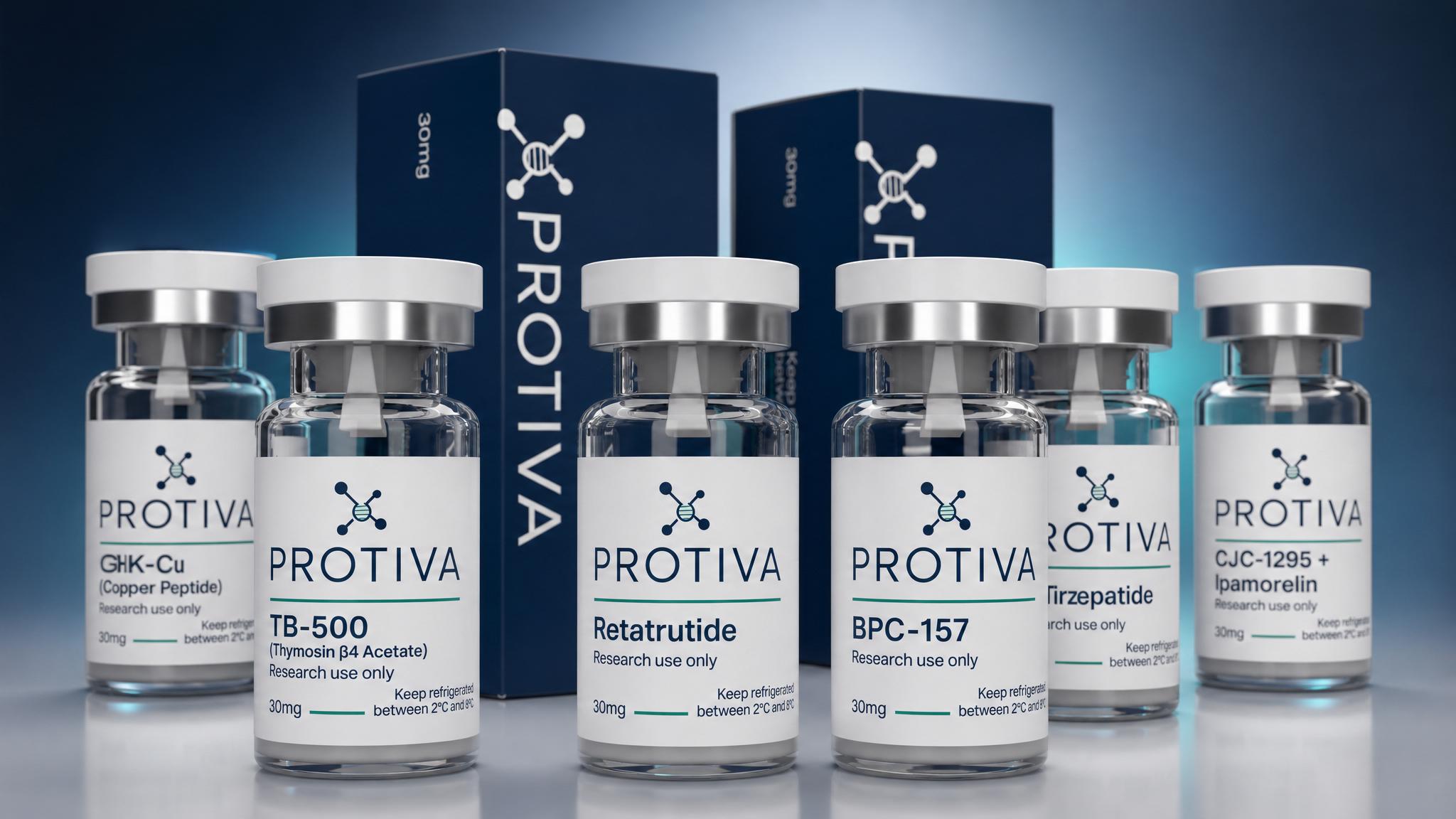
One word — "peptides" — is doing an enormous amount of work right now, covering everything from serious research compounds to mislabelled vials sold on vibes. Here is the plain-English map: what a peptide is, the research families people talk about, why so much of the market is junk, and the four checks that sort legitimate reference material from a scam.
Key takeaways
- A peptide is just a short chain of amino acids — the same building blocks as protein, in a smaller string.
- "Peptides" is a category, not a single thing — it spans wildly different research compounds.
- The families people discuss break down by research context: repair/recovery, growth-hormone-secretagogue, and metabolic.
- The market is flooded with junk because demand outran oversight — mislabelling and underdosing are common.
- Four checks separate legitimate reference material from a scam: HPLC purity, an independent per-batch COA, endotoxin testing, and proper cold-chain storage.
Why peptides are suddenly everywhere
A few forces landed at once. A wave of high-profile scientific interest made "peptide" sound like the future of everything. Social platforms rewarded the word because it was novel, technical-sounding and easy to make mysterious. And a grey market noticed the demand and rushed to meet it. The result is a phrase with enormous reach and almost no shared definition.
That combination — huge interest, low understanding — is exactly the environment where confident nonsense thrives. If nobody can define the thing, nobody can tell when a claim about it is rubbish.
When a word gets popular faster than it gets understood, the confusion becomes the product.
What a peptide actually is
Here is the whole definition, and it is not complicated. A peptide is a short chain of amino acids. Amino acids are the small building blocks that link together to form proteins; string a few of them together and you have a peptide. A very long chain is a protein; a short one is a peptide. That is the entire distinction.
So "peptides" is not one substance any more than "vehicles" is one machine. A bicycle and a cargo ship are both vehicles. Two peptides can share the category and have nothing else in common — different sequences, different properties, studied for entirely different reasons. In this context they are research compounds: reference materials studied in laboratories, not products to use on yourself.
Keep that framing, because it is the antidote to most of the hype. The moment someone talks about "peptides" as if they were a single miracle ingredient, they have already told you they are selling a story, not describing a science.
The main families people research
People tend to group peptides into a handful of research buckets. We will describe them by category only — no compound names, no claims about what any of them will do for a person — because the categories are what actually help you make sense of a conversation.
Repair and recovery research
A cluster of peptides that researchers have studied in the context of tissue, connective-structure and recovery biology, largely in laboratory and animal models. This is the bucket you will hear invoked around training and injury contexts. As always, laboratory interest is a starting point for study, not a demonstrated outcome in people.
Growth-hormone-secretagogue research
A family studied for how it interacts with the body's own growth-hormone signalling pathways. It has a long history in research settings and a correspondingly long history of being over-sold in non-research ones. The scientific interest is real; the marketing claims stacked on top of it usually are not.
Metabolic research
The category that has driven a huge amount of the recent public attention — peptides studied in the context of metabolic and appetite-regulation pathways. It is also the category most surrounded by hype, knock-offs and mislabelled product, precisely because the interest is so intense. We name no compounds and make no claims here; the point is only that "metabolic research" is a research context, not a promise.
Notice what these three descriptions have in common: each is a research context, hedged, with no guarantee attached. That is not us being cagey. It is the honest shape of the evidence.
Why the market is flooded with junk
Intense demand plus light oversight is a recipe, and the market followed it exactly. When a category gets hot faster than anyone can police it, the low-quality supply arrives fast. In practice it shows up as:
- Mislabelling — what's in the vial isn't what's on the label: wrong compound, wrong concentration, or unlisted extras.
- Underdosing — the named compound is technically present, but far below what the label implies.
- Zero testing — nobody independent has verified the contents, so a purity claim is just a number someone typed.
- Improper handling — sensitive material shipped and stored carelessly, so even a good batch degrades before it arrives.
The unifying theme: the story on the outside of the vial has nothing to do with what's inside it. And because most buyers can't test anything themselves, the junk survives on confidence alone. Which is why the only real defence is documentation — the next section.
You can't assess a vial by looking at it. You assess it by reading the paperwork behind it.
The 4 checks: legit vs scam
If a source of research reference material can't satisfy all four, treat the rest of its marketing as noise:
- HPLC purity ≥99%. High-performance liquid chromatography is the standard method for measuring how pure a compound is. Research-grade material is typically quoted at 99% or higher — and the figure should come from an actual test, not a slogan.
- An independent, third-party COA — per batch. A Certificate of Analysis from an outside lab, tied to the specific batch in front of you. A self-issued or generic certificate is marketing, not verification.
- Endotoxin testing. Endotoxins are contaminants that can be present in poorly-made material. Serious suppliers test for them and can show the result.
- Proper cold-chain storage. Many peptides are sensitive and degrade if they aren't kept and shipped cold. Correct handling is the difference between a good batch that arrives intact and one that's already spoiled.
A short glossary
The words that come up most, in plain English:
- Peptide — a short chain of amino acids, the same building blocks as protein, in a smaller string.
- Amino acid — the individual building block; link enough together and you get a peptide, then a protein.
- HPLC — high-performance liquid chromatography, the standard laboratory method for measuring how pure a compound is.
- COA (Certificate of Analysis) — a lab report stating what a specific batch contains and how pure it is. Most useful when issued by an independent third party and tied to the exact batch.
- Endotoxin — a type of contaminant that can appear in poorly-manufactured material; reputable suppliers test for it.
- Cold chain — keeping sensitive material cold through storage and shipping so it doesn't degrade before it reaches the lab.
- Research use only — a label category meaning the material is intended for in-vitro laboratory research, not for human or veterinary use.
Where that leaves you
With a working map, which is the whole aim. You now know that a peptide is simply a short chain of amino acids; that "peptides" is a category spanning very different research compounds; that the families people discuss are research contexts rather than promises; and that the flood of junk is a predictable consequence of demand outrunning oversight. Most of all, you know the four checks — HPLC purity, an independent per-batch COA, endotoxin testing and proper cold-chain storage — that quietly separate real reference material from a confident scam.
See the four checks applied
If you want to see those four checks in practice — research reference material specified to ≥99% by HPLC, with an independent per-batch Certificate of Analysis in every box — that is the standard Protiva supplies to. These are research reference materials for in-vitro laboratory use only; nothing here is a suggestion to use anything on yourself. The whole point is that the paperwork should exist before the purchase does.
Research use only
All Protiva products are supplied strictly for in-vitro laboratory research and development. They are not medicines, food, cosmetics or supplements, and are not intended for human or veterinary consumption, administration, clinical, diagnostic or therapeutic use. By purchasing, you confirm you are a qualified purchaser acquiring these materials solely for lawful scientific research. No therapeutic or health claims are made or implied.