
Research notes
Copper peptides (GHK-Cu): what they actually are
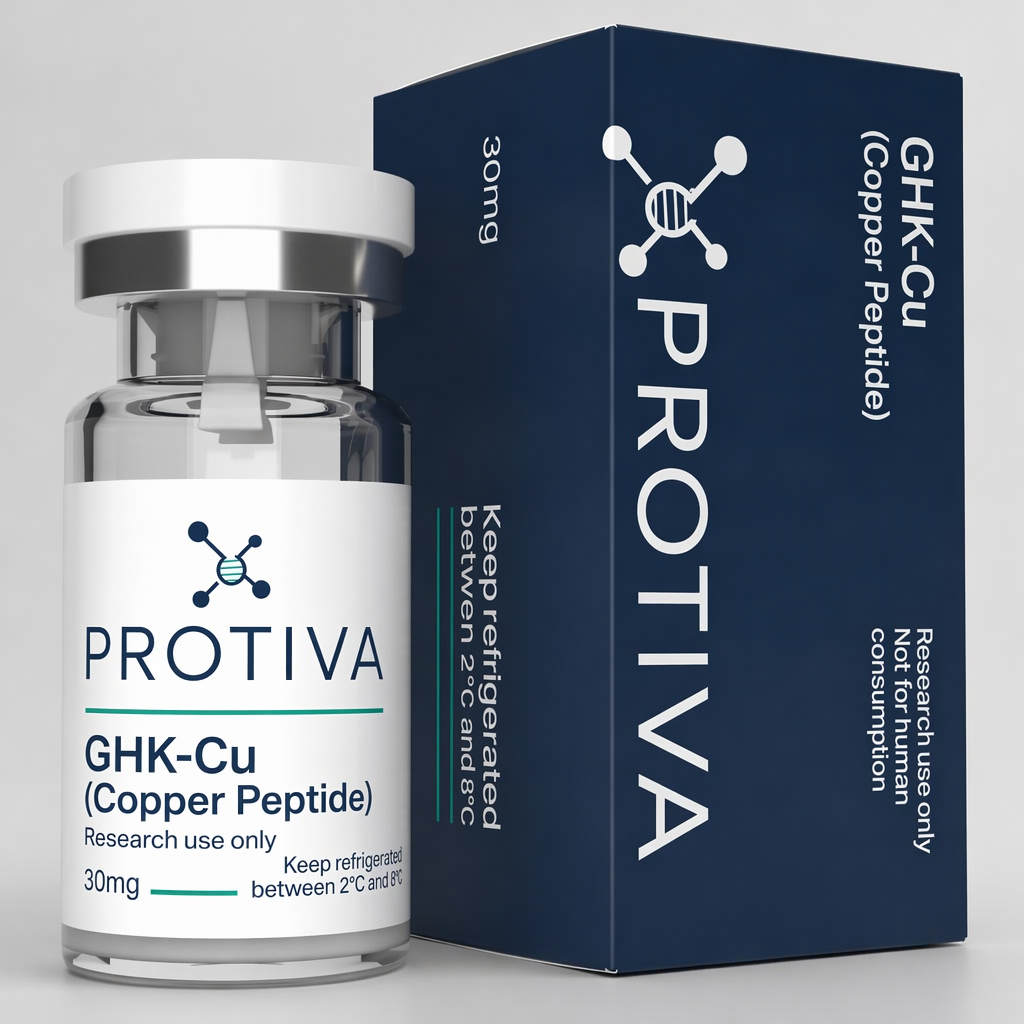
"Copper peptides" gets said with the confidence of a settled fact — the way people once said "retinol" or "niacinamide" — and then the conversation moves on before anyone explains what the thing actually is. Here is the plain-English version: what GHK-Cu is, why interest spiked, what the published research has explored, and why the specific material behind the word matters far more than the word itself.
Key takeaways
- GHK-Cu is a naturally-occurring copper-binding tripeptide first described in human plasma in the 1970s — it is not new.
- The recent spike in attention is a search-trend and social-media story, not a scientific breakthrough.
- Published research has mostly explored it in laboratory and skin-model contexts — interesting, but not a promise.
- The real variable is quality: much of what circulates is underdosed, mislabelled or never independently tested.
- The single most useful skill is reading a Certificate of Analysis (COA) — covered below.
Why "copper peptides" blew up
Nothing about GHK-Cu itself changed recently. What changed is distribution. A handful of large skincare accounts name-dropped "copper peptides" in the same few weeks, the phrase tested well in the first few seconds of a video, and the recommendation engines did what they do — they found more people who paused on it and served them more of it. Search interest for the term climbed steeply over a single season.
That is worth saying plainly, because it reframes everything that follows: a spike in interest is a story about attention, not about evidence. The molecule did not get better because more people started saying its name. If anything, a surge in demand is exactly the moment a market fills up with low-quality versions of whatever is trending — a point we come back to.
A trend tells you what is popular. It tells you nothing about what is in the vial.
What GHK-Cu actually is
GHK is a tripeptide — a chain of just three amino acids (glycine, histidine and lysine, hence "GHK"). The "-Cu" means it is bound to a copper ion. Put together, GHK-Cu is a naturally-occurring copper-binding peptide complex that was first isolated from human blood plasma and described in the scientific literature back in the 1970s. It also appears in saliva and other tissues.
Two things follow from that. First, this is not a synthetic novelty someone invented for a serum launch — it is a molecule the body already makes, and researchers have been characterising it for roughly half a century. Second, because it is a small, well-defined peptide, it can be manufactured to a known structure and, crucially, measured — which is what makes the quality question answerable rather than a matter of faith.
What the research literature has explored
Here it pays to be careful with language, because this is exactly where a trend video tends to over-promise. So, hedged and honestly: over several decades, researchers have studied GHK-Cu in a range of laboratory and skin-model contexts. Much of the published work sits in areas like skin biology, collagen and extracellular-matrix research, and wound-healing research — often in cell cultures or animal models rather than large human trials.
That body of work is genuinely interesting, and it is why the molecule has a scientific reputation at all. But interesting is not the same as proven, and a cell-culture finding is not a claim about a person. The honest summary:
- There is a real research literature. GHK-Cu is not a made-up ingredient — it has been the subject of published studies for decades.
- Much of it is early-stage or laboratory-based. A lot of the most-cited work is in vitro or in animal models, which is a starting point, not a conclusion.
- Marketing tends to sprint ahead of the evidence. The gap between "studied in laboratory research" and the promises stacked on top of it is enormous, and that gap is where most of the hype lives.
The research explores mechanisms and contexts. It does not hand out guarantees, and any source that offers you certainty where the literature offers a hypothesis is telling you something about their selling, not about the science.
The catch nobody posts about: quality
This is the part that actually matters, and it is the part the trend never mentions. Assume, for the sake of argument, that everything interesting about GHK-Cu holds up. None of it means anything if the material in front of you isn't what the label says.
Because peptides sit in a lightly-policed corner of the market, a surge in demand pulls in a lot of low-quality supply. In practice that shows up as three recurring problems:
- Underdosing. The named compound is present, but at a fraction of the amount implied — enough to justify the label, not enough to matter.
- Mislabelling. What is in the vial is not, or not only, what is printed on it — wrong compound, wrong concentration, or unlisted extras.
- No independent testing. Nobody outside the seller has verified the contents, so "99% pure" is just a sentence someone typed.
The antidote to all three is the same, and it is unglamorous: purity you can verify, and a per-batch Certificate of Analysis from an independent lab. A COA is a third-party report that states what a batch actually contains and how pure it is. Without one, everything else — the brand, the marketing, the trend — is decoration.
How to read a COA in 30 seconds
A Certificate of Analysis looks intimidating and mostly isn't. Here is the fast pass, top to bottom:
- Does it exist at all? If a supplier can't produce one, stop there. Everything below is moot.
- Whose name is on it? Look for an independent, third-party lab — not the seller's own say-so. A self-issued certificate is marketing.
- Does the batch number match? The COA should reference the specific batch in front of you, not a generic PDF reused for everything.
- What's the purity figure? Look for an HPLC purity result and check it clears a high bar — research-grade material is typically quoted at ≥99%.
- Is it recent? A COA has a date. An old certificate for a new batch tells you nothing about the new batch.
Where this leads
You now know that GHK-Cu is a real, decades-old, naturally-occurring tripeptide; that the excitement is a distribution story rather than a discovery; that the research literature is genuine but mostly early-stage and hedged; and that the single biggest variable is whether the material has been independently verified. That last part — purity and a per-batch COA — is the whole game, and it is the one thing the trend will never put in a caption.
See the standard applied
If you want to see what "research-grade, COA-backed" looks like in practice — GHK-Cu reference material specified to ≥99% by HPLC, with an independent per-batch Certificate of Analysis in every box — that is the standard Protiva supplies to. These are research reference materials for in-vitro laboratory use only; nothing here is a recommendation to use anything on yourself. The point is simply that the paperwork should exist before the purchase does.
Research use only
All Protiva products are supplied strictly for in-vitro laboratory research and development. They are not medicines, food, cosmetics or supplements, and are not intended for human or veterinary consumption, administration, clinical, diagnostic or therapeutic use. By purchasing, you confirm you are a qualified purchaser acquiring these materials solely for lawful scientific research. No therapeutic or health claims are made or implied.